Brought to you by New Model Adviser
Our first Forecast edition takes a deep dive into multi-asset investing
Weathering the storm
How bad weather can blow through your portfolio
Multi-ASSET
sponsors
contents
Listen
Watch
Read
AN ILL WIND
Content from: BMO
Multi assets: time to broaden your horizons
Investing for new weather fronts with Alex Monk
podcast
How much are you allocating to bonds?
poll
Bigger is not better in multi-asset
performance pattern
Vote
Climate change will send costs rocketing, right?
FOOD PRICES
Content from: Ninety One
An alternative solution to a bleak outlook for yield
Content from: 7IM
A journey, not a race
Images credit: Unsplash and Istock
Multi-assets: time to b roaden your horizons
Structured CPD Programme
Earn one hour of structured CPD, endorsed by the CII
structured cpd
When we think about mixed-asset funds, diversification is taken as a given. Afterall, the point of ‘go anywhere’ funds is that they are not limited to a single asset class or by geography. If one part of the world is not doing well, you can go somewhere else. But not even multi-asset funds are immune to changes that affect the whole planet, such as global warming. It is good to start any journey with a tailwind so, to understand how climate affects mixed-asset investing, New Model Adviser started by following the flows. We looked at funds in the last year’s most popular GBP mixed-assets sector: aggressive. We then looked at the two most popular actively managed funds and asked: How can the weather affect a mixed asset portfolio? And what can we expect from the long-term climate forecast?
by Charles Walmsley, special features editor
Your multi-asset fund is not immune to climate change
Findlay Park American
Findlay Park American is the most popular holding in mixed-asset portfolios, according to Citywire data. It is held by 24 mixed-asset funds. One of the fund’s top holdings is T-Mobile. The mobile phone network provider had a strong 2020, with shares returning 66.7% over the year. According to Findlay Park American’s fourth-quarter commentary, T-Mobile has-first mover advantage in the US in the roll-out of the faster 5G technology, since it acquired rival network Sprint Corporation in April last year. But quicker download speeds are not everything. Recent storms that swept across the US knocked down T-Mobile’s network in many parts of Texas, including Austin, Dallas and Houston, leaving people without mobile or internet connection. This is a massive problem for the business. Although the problems were cleared up within a few days, the downtime highlighted a major frailty within a key part of infrastructure. With extreme weather more likely because of climate change, particularly in the US where last year’s hurricane season was the most active on record, phone networks face more problems. Some experts say 5G could be better placed to deal with storms because it uses fibre optics rather than copper cables. Fibre is not only quicker at sending information but also more resilient than the copper traditionally used in networks. It does not degrade as quickly and is waterproof, whereas copper needs some form of insulation that can be breached, handing fibre an advantage in a storm.
With extreme weather more likely because of climate change, particularly in the US where last year’s hurricane season was the most active on record, phone networks face more problems
‘In most cases, passive fibre systems are really rugged,’ said Tony Grubesic, associate dean for research in the School of Information at the University of Texas at Austin, in an article on S&P Global Market Intelligence published last year. ‘The lines can be flooded or submerged and maintain operation.’ The question is how much T-Mobile is using fibre. While it has rolled out the high-speed 5G service to more customers than anyone else in the US, stating in July last year that 22.5% of its customers have access to 5G, it is harder to find how that service is delivered. Finding information on Wi-Fi services available in the US is not easy, and there is more information available about AT&T and Verizon than T-Mobile. For most customers, the way their Wi-Fi or mobile data are provided does not matter so long as it is working. But the way it is delivered will become more important as weather patterns continue to change. Lockdown and home working have also benefited T-Mobile. It was fair to say T-Mobile chief executive Mike Sievert was in a bullish mood after the results were published, aiming a somewhat Trumpian shot at rivals Verizon and AT&T. ‘In a quarter when Verizon sacrificed growth for profitability, and AT&T sacrificed profit growth for customer growth, only T-Mobile delivered customer and profitability growth, beating consensus on both,’ Sievert said. ‘We’re about to take all of their customers.’ Taking a long term view, however, will require building internet infrastructure that can withstand extreme weather conditions.
Mixed-asset funds in the Aggressive GBP sector are turning to the £5.1bn BlackRock European Dynamic fund. It is the second most popular active fund pick according to Citywire data, selected by 21 strategies. Although the fund has a European focus with just 3.6% allocated to UK-listed companies, shifts in the weather mean a top holding is having to reconsider its model. LVMH Moët Hennessy Louis Vuitton (LVMH) is, if you had not guessed, a luxury goods company. It owns fashion brands such as the titular Louis Vuitton and Christian Dior, watchmakers TAG Heuer and Hublot, and even two luxury yacht retailers. If it is advertised in the Financial Times weekend supplements, there is a good chance LVMH owns it, and the BlackRock European Dynamic fund invests in it. But even luxury brands are not immune from climate change. Wine plays an important role for LVMH. It owns several champagne producers within the company, including Dom Pérignon, Krug Champagne, and Moët; three well-known names in luxury wine.
BlackRock European Dynamic
As weather changes in the Champagne region in the northeast of France, so does the produce of its vineyards. That part of the world has seen more heatwaves each summer, and they are hotter too. Grape-growing is also facing a more volatile season of frosts throughout the winter and spring. Valéry Laramée de Tannenberg, a journalist and environmental expert, has estimated that average temperatures in the region rose by 1°C over the last 50 years. In a process as finely-tuned as winemaking, that makes a difference. In some ways, British vineyards have been the beneficiaries. Warmer weather in places such as Kent has allowed winemakers to produce their own versions of sparkling wine. I can personally vouch for Battersea producer Blackbook Winery’s GMF sparkling, for example.
The change in weather has led several big names in French winemaking to buy vineyards in the UK. Taittinger owns a vineyard called Domaine Evremond just outside Kent, and has been expanding it since first planting vines there in 2017. According to trade publication The Drinks Business, Pommery became the first French champagne house to release an English fizzy wine in 2018. And The Telegraph reported last summer that LVMH was looking to get in on the act, although nothing has materialised since. Before any corks are popped, it is important to note that changes in weather patterns in the UK have also made it difficult to grow with any certainty. An article in Smithsonian Magazine last year highlighted the problem. ‘With climate change also comes changeable and unpredictable weather patterns, making it very difficult to forecast and adapt farming techniques accordingly,’ said Charlie Holland, head of winemaking at Gusbourne vineyard. LVMH only has to look to one of its companies outside of Europe to see the damage changing weather can cause. Last October, the Glass Fire ripped through the Napa Valley in California. Although the causes were unknown, many environmental scientists attributed the large number of wildfires over the period to climate change and unusual heatwaves. In its annual report for 2020, LVMH said the Glass Fire ‘caused irreparable damage to the Newton Estate winery and vineyards’ that it owns.
From wrecked telecommunications to scorched vineyards, increasingly erratic weather is wreaking havoc across all sectors
7IM BMO NinetyOne
Sponsored content
An Ill Wind Podcast Poll Performance Pattern Food Prices CPD Quiz
editorial content
Increasingly extreme weather around the world is putting companies under pressure. From storms knocking out communication networks in the US, to flooding hitting supply chains in parts of the UK, businesses are having to adapt to the future. Alex Monk, co-manager of the Schroder Global Energy Transition fund, explains what this means for investment portfolios. We discuss the companies adapting to the new world, the economics of going green, and the businesses that are doing something to change the course of climate change.
30:05 / 1:14:25
Title of the podcast
7IM BMO Ninety One
Ut ped que nisci officim aliatent dita volupti aturem. Equia culparu metur? Quidit verum eateceate officias et expeliq uisimin nonsent pos mi, sincil is amet aditiam, voluptat renist eatquam, inis est lab inverum et fugit quam arum qui doloribus mi, comnis et libus quist laborit quatio. Cus diam eos eos dolendus pos de cus rem untis inum reptatur sundus, consectatis et essites erro eati optatur sapiendunt.
PERFORMANCE PATTERN
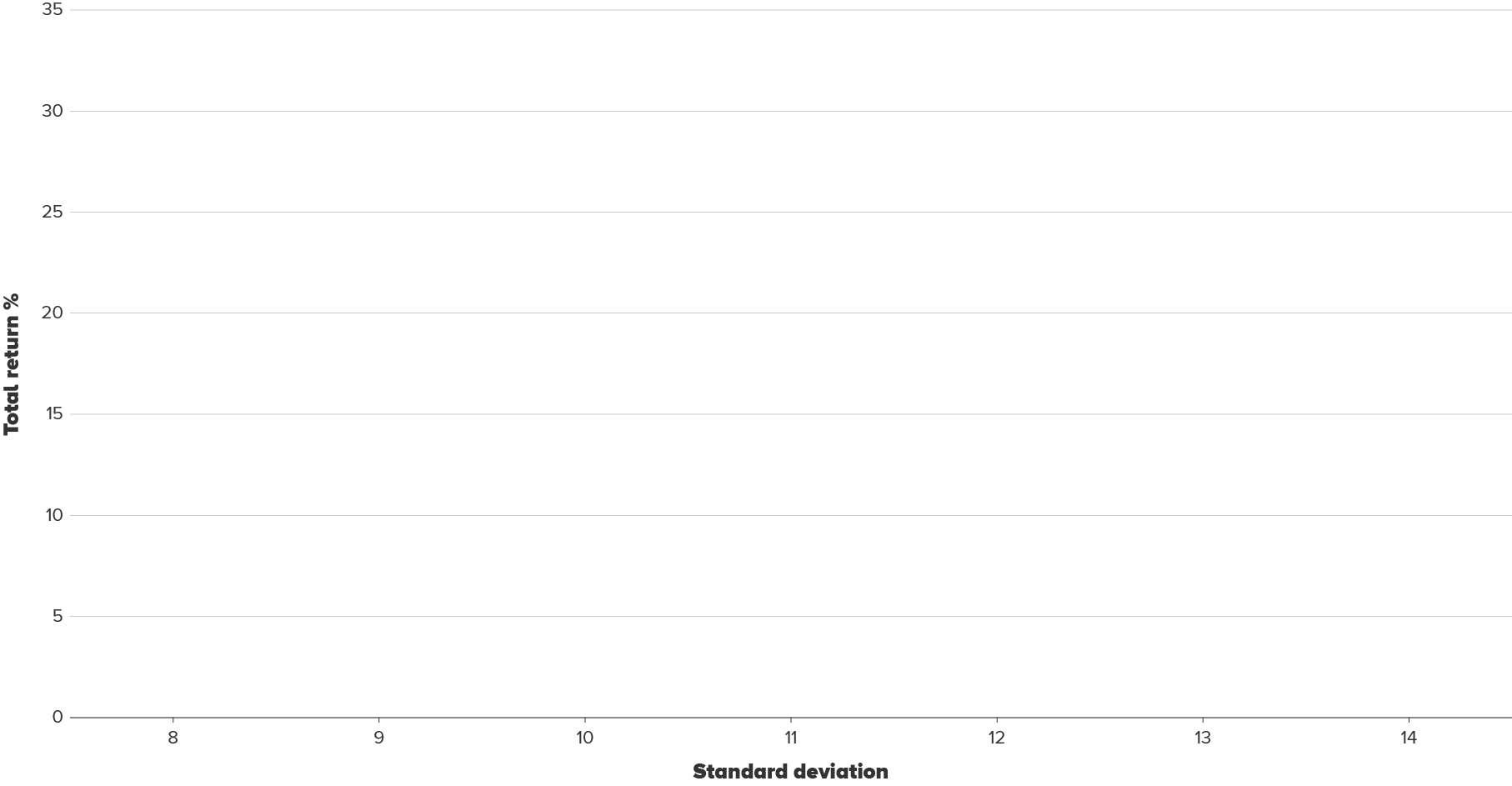
Some of the multi-asset funds that have enjoyed the biggest flows have not been the best performers, and vice versa. We picked out a few familiar names and some less well-known funds from our mixed-assets balanced (GBP) sector, and plotted them using our performance data on a risk-return basis. Use the infographic to see how these big and small funds weathered the last three years. Hover over the bubbles to reveal their size and name.
Bigger is not better in multi- asset funds
ASI MyFolio Managed III Fund
£3,7bn
Quilter Investors Cirilium Balanced Port
£3.0bn
Schroder Diversified Growth Fd
£4,7bn
Jupiter Merlin Income Portfolio
£2,0bn
Global Multi Asset
£35,5m
Rathbone Pharaoh Fund
£44,5m
Barclays Multi-Impact Growth Fund
£34m
Royal London Sustainable Diversified Tr
£2,6bn
by Will Robins, Editor
We all know inflation measures include a host of things: energy, leisure activities, and housing. But a key component of any inflation basket is food – we cannot stop buying the stuff. As climate change makes the world’s weather more volatile, it makes sense to assume all those floods, fires and ice storms will end up killing key crops. The truth is a little more complicated. New Model Adviser editor Will Robins searches for some answers.
CONTENT BY
In 1872, Jules Verne sent the fictional globetrotter Phileas Fogg Around the World in Eighty Days. It’s a stressful experience for Mr Fogg, involving drugs, robberies, mutinies, steam boats and elephants. Interestingly, given modern depictions, the novel does not feature a hot air balloon. It makes for a great story. But let’s think about a different version of the story. Imagine that it wasn’t a race, and that Mr Fogg was to travel round the world at a leisurely pace. The destination would be the same, but with no hurry at all. The key thing to consider (as always with holidays) is packing. Because thinking about packing for the two trips helps us to think about multi-asset investing. If you’re packing for a race around the world, you consider what you can and can’t do without. You think about how to do the journey as quickly as possible – there’s no room for stuff that might not be needed. You probably take a rucksack packed as lightly as possible. Ideally, you should take everything you will definitely need … and nothing else. And if you get lost in the Sahara and don’t have a tent and extra water bottles, that’s just too bad. You’re on a race. You can’t allow for everything that could go wrong. And if the worst happens and you weren’t prepared, you might never finish the race. But if you’re doing the laid-back version of the trip you think differently. You’re not racing anywhere, so why worry about being streamlined? You can take some clothes that you might not need, some books that you might not read, and a whole host of accessories ‘just in case’. You want to make sure that whatever awaits you on the journey, you’re prepared – and if you get back and the flip-flops/safari hat/arctic gear have not been used, well, that’s ok.
by Ben Kumar, Senior Investment Strategist
A trip around the world
Packing a multi-asset bag
Someone running a UK stock-picking portfolio is trying to win a race. They want to pick shares that will beat a benchmark. On good days, the shares they choose will do better than the market, and on bad days, they’ll do worse. Those days roll into months and years – and if they’re a successful manager, they’ll have more good than bad; more wins than losses. If all the stocks they picked outperform the market, they’ve run a perfect race (which never happens). More than likely, many of their risks along the way don’t pay off. And some stockpickers get it wrong and bomb out. Remember Neil Woodford? But multi-asset investing isn’t a race. It’s not about picking the winning stocks, nor about avoiding the losers. In fact, viewing portfolio outcomes as a game to be won or lost is the wrong strategy. You have to think differently from the very start. Thinking differently about multi-asset investing is acknowledging that you’re travelling at your leisure. You want to end the journey safe and well, and having enjoyed it as much as possible. It’s not about the race, so pack whatever you might require in your suitcase – in fact, take two or three suitcases along and settle in for the long haul.
Deliberately over-packing
Being prepared means accepting that you won’t be travelling light. When you’re in the Sahara, those snow-shoes aren’t going to look too clever, and nor is the snorkel. But a multi-asset manager knows that there is other terrain ahead, so keeps on carrying the items that someone else might cast aside. Across a diversified multi-asset portfolio, the aim is not to have every single position be a winner at the same time – in fact, that’s a poor outcome. If you’re perfectly equipped for the desert, you’ll struggle in the jungle or on the steppe. It is about ensuring that the fund is reasonably well positioned for most investment environments, even if they seem unlikely right now. When you’re travelling, that means lugging those suitcases along. In the multi-asset world, that means expecting to have some part of the portfolio losing money at any given time. In fact, allocations should be designed that way in the first place. A multi-asset manager should always hold some assets that they think will lose money in their main scenarios – just in case they turn out to be horribly wrong. The world is complicated and erratic. Bad things happen to even the best investors. Good multi-asset portfolios are broadly diversified, designed to survive bad periods and nasty surprises.
Thinking differently
Constantly buying things that you think could lose money is not as easy as it sounds! There will always be a compelling argument about why, in a specific case, a certain investment will be poor. The argument may even be right short term. But abandoning long-term return drivers for short-term performance leads, eventually, to trying to time the market and only picking the assets that have done well recently. You end up thinking about a race, not a journey. At 7IM we have a tried and tested framework for portfolio construction, which means we’re prepared for anything that comes our way. This framework – our Strategic Asset Allocation – has proven itself repeatedly over the last 18 years, through the ’08 crisis and recovery, through Brexit and now, again, through Covid-19. Our pile of suitcases is meticulously packed, and we’re not sorry about it. And we have an investment team that’s always looking to improve the journey. Whether it’s a more scenic route, a new experience, or a more comfortable mode of transport, we’re prepared to investigate and engage. With a strategic framework as solid as ours, we’re well placed to go and look at tactical opportunities without getting carried away and caught up in mad sprints – we know that if the world changes (and it will), large parts of our portfolios will already be in place and prepared. We’re about the journey, not the race.
Ben Kumar is a Senior Investment Strategist at 7IM
Paul Niven: There is a lot of uncertainty over future monetary and fiscal policy, while the outlook for earnings is clearly also uncertain. For investors looking for a targeted outcome, our view is that, in this environment, it will help to have access to a broad range of assets to deliver returns and manage risk. But as the universe of opportunities and tools available expands, so too does the complexity of managing them. The combination of this complexity and the uncertain macro-economic backdrop lends itself to a highly structured multi-asset approach. Our approach is to diversify across different sources of return to deliver particular client outcomes. These are driven by a range of processes, but the keys for us are strategic asset allocation, which takes a longer-term view to portfolio positioning, tactical asset allocation, which helped us to exploit opportunities during the tremendous volatility of the last 12 months, and then security selection. These tools give us the ability to structure multi-asset solutions that take account of client preferences.
by Paul Niven, head of multi-asset investment and Simon Holmes, director and fund manager in the multi-asset team
Multi-asset: Time to broaden your horizons
Paul Niven: We definitely acknowledge that it’s a big challenge to deliver income in this environment. To us, it makes sense to balance income and capital, to focus on total return. What this means from our perspective is that higher yields or a higher income targets might be achievable, but that might be to the detriment of capital and total return. Investors need to think very carefully and consider what is a sensible and sustainable level of yield or income they should target. We think that around a 4% level of income is achievable while maintaining or growing capital, by investing in a risk-controlled way across equity and fixed income, which we then supplement as required with derivative strategies to meet an overall income target without compromising total returns. Obviously it could be possible to achieve a higher income target, but it might not be a good idea in total return terms. There are plenty of examples, particularly in the equity space over recent years, of stocks that might be bought for income but the gain is more than offset by a loss in capital terms, because of course high income equities have been a material area of underperformance against the broader market.
Simon Holmes is a Director and Portfolio Manager in the Multi-Asset team at BMO GAM
This is a challenging environment for investors: valuations are high across all asset classes, and there are significant challenges from Covid and its aftermath. Why are multi-asset portfolios suited to this environment?
Income is in short supply in the market now, thanks to low sovereign yields, tight credit spreads and companies cutting dividends. How can multi-asset portfolios deliver income in these conditions?
What are the advantages of your products over a low-cost tracker fund?
Paul Niven: We’ve removed a lot of the cost differential between active and passive funds by creating low cost active multi-asset solutions priced at 0.29% OCF and 0.39% OCF for the sustainable range. We add value via strategic asset allocation, tactical asset allocation and stock selection. But a further key advantage over passive products is that we don’t have a static approach to portfolio allocations, and the last 12 months have provided an example of how a dynamic and active approach can add value. I’d also point to our credentials in terms of ESG, which is ingrained in all of our products, but we also have a sustainable universal range, which seeks to invest for good and is also available at a low price point.
With so many uncertainties in the market, how are you positioning yourselves currently?
Simon Holmes: Valuations do look high, but there are a number of factors to consider. First, with earnings so depressed, price/earnings ratios look high, but looking forwards, when earnings start to rebound then those measures could come down. Second, when considered against bonds, equities look less expensive, and it’s important to remember there’s a huge amount of fiscal and monetary policy support going on to help both the economy and equity prices. There are plenty of reasons why we think equities are still a very good asset to hold. The other point is that there are few other places to invest at the moment. Fixed income is much less interesting from an investment point of view; there’s still a diversification benefit, but not as much as in prior times. We would say that there may well be some pockets of real excess in the markets, particularly with some of the valuations of some tech stocks in the US. But that’s quite different from saying the whole market is in that situation. There are many sectors where the best companies can expect good growth and earnings, and investors should benefit from that rebound even if the valuation today may look a bit high. We don’t want to be complacent, but we think we are in an early phase of the cycle with a rebound to come. We still have a bias towards risk assets, predominantly equities.
You mentioned that valuations of some of the US tech companies are looking high. Given that sustainable funds tend to have a bias to tech and healthcare, is that a worry for you?
Simon Holmes: This is where we see an active approach as very important, because as long as you’re picking the right stocks, it’s not a problem. We think a lot of the trends towards healthcare have been accelerated by Covid, and there’ll be plenty more investment in that sector. On the tech side, it’s not just about companies like Facebook, it’s also about the ways that technology helps to solve problems and, seen through that lens, there are many opportunities around better use of IT and information. For example, in industrial sectors the drive to reduce carbon emissions and use energy more efficiently is becoming really strong. Any company that can help to improve in that area is going to do really well. So that allows us to have exposure to more industrial-type names in specific parts of that chain, which helps us to move away from over-concentration in some of the high-level technology themes.
Paul Niven is Head of Multi-Asset Investments at BMO GAM
We’ve removed a lot of the cost differential between active and passive funds by creating low cost active multi-asset solutions. We add value via strategic asset allocation, tactical asset allocation and stock selection
The value of investments and any income derived from them can go down as well as up as a result of market or currency movements and investors may not get back the original amount invested.
For more information on the BMO Universal MAP and BMO Sustainable Universal MAP ranges, how they can be included in your financial planning scenarios or to speak to a member of the team, please contact Sales.Support@bmogam.com or 0800 085 0383 or visit RedefiningValue.com
Investors have been struggling to find yield from traditional sources since the global financial crisis, and this has been exacerbated by COVID. The policy response to the pandemic accelerated pre-existing trends and pushed interest rates to previously unthinkable levels as central banks doubled down on using ever-looser monetary policy in an attempt to protect the economy. Investors now face very limited options with respect to defensive assets, such as cash and developed market sovereign bonds. Even high yield corporate bonds now offer very little income. In addition, given the fiscal support for lower unemployment, central banks trying to stoke inflation and the likelihood of pent-up consumer demand being unleashed as we gradually return to normality, there is a reasonably high probability of an inflationary scenario transpiring, especially in the US. Against a backdrop of low yields and possible inflation, we believe the future for fixed income assets and their ability to provide income is bleak.
by john stopford, head of multi-asset income
John Stopford is Head of Multi-Asset Income at Ninety One
Calendar year performance [2]: 2020: 4.6%; 2019: 5.4%, 2018: 0.4%; 2017: 4.8%; 2016: 5.9%; 2015: 2.0. Performance and volatility targets are subject to change and may not necessarily be achieved, losses may be made. Past performance is not a reliable indicator of future results. The amount of income may rise or fall. The Fund may invest more than 35% of its assets in securities issued or guaranteed by a permitted sovereign entity, as defined in the definitions section of the Fund's prospectus. This is an advertising communication for institutional investors and financial advisors only, and not for public distribution. Ninety One has prepared this communication based on internally developed data, public and third party sources. Although we believe the information obtained from public and third party sources to be reliable, we have not independently verified it, and we cannot guarantee its accuracy or completeness. Ninety One’s internal data may not be audited. Ninety One does not provide legal or tax advice. Prospective investors should consult their tax advisors before making tax-related investment decisions. This communication is not an invitation to make an investment nor does it constitute an offer for sale. Any decision to invest in the Fund should be made after reviewing the full offering documentation, including the Prospectus, which sets out the fund specific risks. Fund prices and copies of the Prospectus, annual and semi-annual Report & Accounts, Instruments of Incorporation and the Key Investor Information Documents may be obtained from www.ninetyone.com. Except as otherwise authorised, this information may not be shown, copied, transmitted, or otherwise given to any third party without Ninety One’s prior written consent. © 2021 Ninety One.
Casting the net wide
To navigate the environment ahead, we think it is important to cast the net wide and take advantage of a broad multi-asset opportunity set. For example, we see compelling opportunities in high yielding equities whose dividends are underpinned by strong cash flows. As the world recovers and returns to normality, these cash flows can rise, which in turn can fund distributions to investors. Fixed income isn’t completely barren, but it is crucial to be selective, focusing on those yields that are backed by resilient cash flows and compensate for the level of risk taken. Crucially, given the less reliable diversification and returns offered by traditional fixed income assets, the need to manage risk at a portfolio level is paramount.
Delivering a defensive income
For those investors seeking a stable, defensive income stream, we’d encourage them to look across the whole market for the best opportunities, be flexible enough to take advantage and be able to weather less stable market conditions. In essence, this is the core philosophy of the Ninety One Diversified Income Fund, which has been successfully accomplishing this since 2012. The Fund aims to produce a defensive total return which, to us, is participating in up markets to a greater degree than when markets are falling, we use resilient income as the engine of these total returns, and look to achieve this with `bond-like’ volatility – less than half the level of UK equities. [1]
How is this achieved in practice?
To achieve a defensive total return, driven by resilient income, we select individual securities from the bottom-up on a cross-asset basis. We ensure that all positions are aligned to our objectives by selecting securities on three criteria: yield, resilient income-generating capacity and the prospect for modest capital growth. We then combine securities together based on how they behave as opposed to their asset class label as we believe a blend of asset characteristics, rather than a blend of assets, results in superior diversification and therefore delivers more consistent outcomes. Finally, in order to limit drawdowns and downside risk during bouts of volatility, we hedge exposures to protect capital.
Reliability in an uncertain environment
Given the weak fixed income outlook, and equities reaching ever more lofty valuations that are vulnerable to correction should the road to recovery disappoint, the outlook remains uncertain. Our team is used to navigating uncertainty, having protected portfolios during weaker markets for bonds (2018) and equities (2015, 2018, 2020), whilst also capturing upside during stronger periods. In fact, the Ninety One Diversified Income Fund has delivered a positive total return in each of the eight calendar years since inception– the only OEIC of all funds in the total return and mixed asset Investment Association sectors to do this – producing an annualised return of 4.6% net of fees. [2] For those looking for a smoother journey ahead, no matter what the environment, we believe such a track record makes the Fund a strong candidate to be a reliable core holding in investor portfolios.
1. UK Equities defined as FTSE All Share TR. ‘Bond-like’ volatility defined as less than half that of UK equities. These internal parameters are subject to change not necessarily with prior notification to shareholders.
2. Source: Morningstar, 31 December 2020. Performance is for the I Acc share class, net of fees (NAV based, including ongoing charges), gross income reinvested (net of UK basic rate tax pre 5 April 2016) in GBP.
John Stopford is Head of Multi-Asset Income at NinetyOne